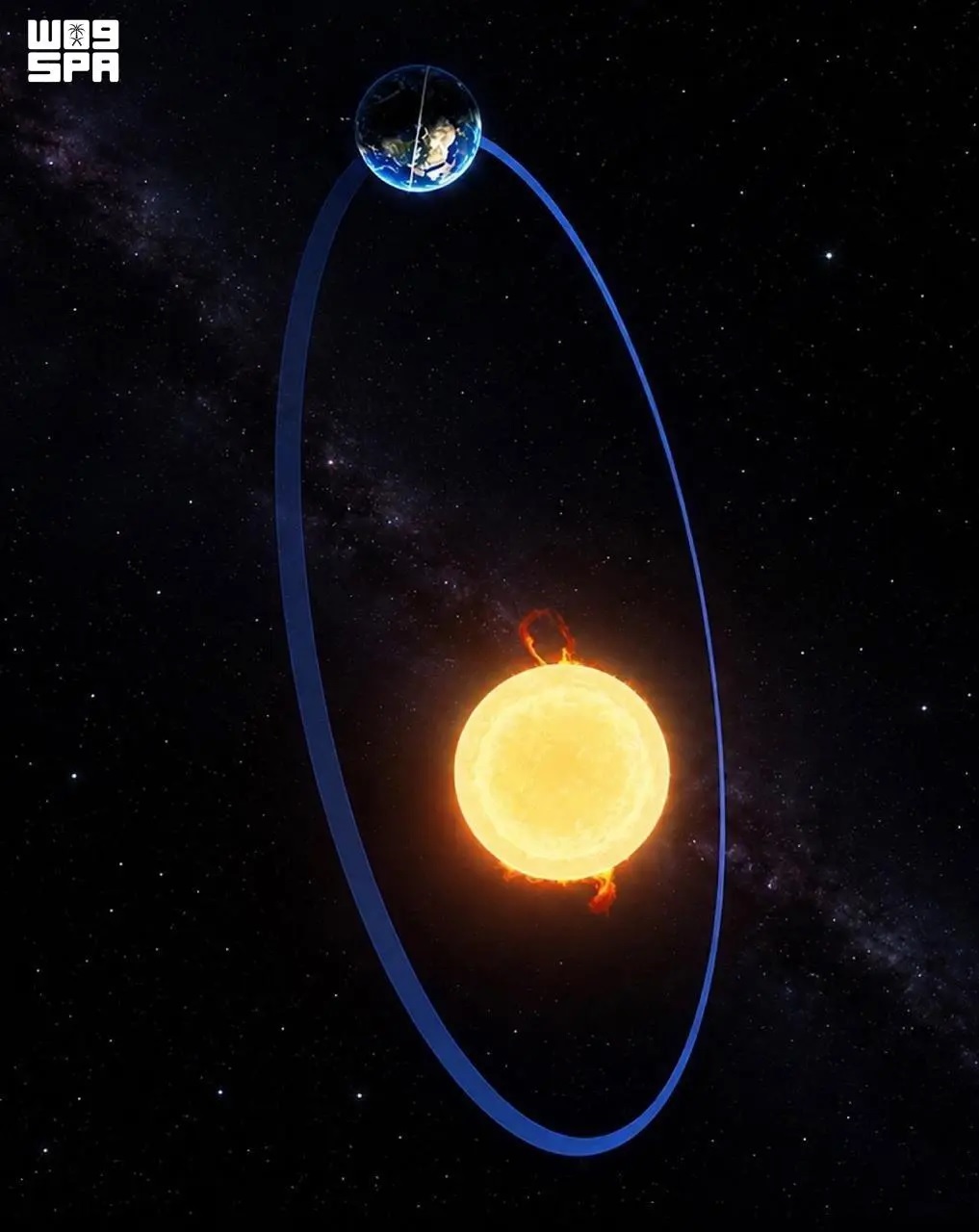
Jeddah Astronomy Society Marks Earth's Aphelion as Planet Reaches Farthest Solar Point
Earth will reach aphelion today at 8:30 PM Makkah time, when it is farthest from the Sun in its orbit at a distance of approximately 152 million kilometers, an annual astronomical event that confirms that seasonal changes are driven not by Earth’s distance from the Sun but by the tilt of its rotational axis.
Jeddah Astronomy Society Director Majed Abu Zahra said that Earth's arrival at this point does not mean lower temperatures, as the changing seasons are not linked to Earth's distance from or proximity to the Sun, but rather to the approximately 23.4-degree tilt of Earth's axis, which causes the Northern Hemisphere to receive the Sun's rays at a steeper angle during summer.
He added that Earth's orbit is elliptical, causing the distance between Earth and the Sun to vary by about five million kilometers throughout the year. The Sun also appears slightly smaller at aphelion than at perihelion, although the difference cannot be detected with the naked eye.
Abu Zahra noted that Earth travels slower at aphelion, making summer in the Northern Hemisphere slightly longer than winter. He stressed that these phenomena are part of the natural orbital variations that help scientists better understand climate and the evolution of the seasons over time.