Prince Mohammed bin Salman Royal Reserve Records Global Achievement in Tracking Desert Ghost
Prince Mohammed bin Salman Royal Reserve has deployed and retrieved GPS tracking collars on six sand cats (Felis margarita), the first time this technology has been successfully used for the species globally.
By safely capturing, collaring and sampling six individuals, the reserve’s research team has combined GPS tracking and genomic analysis to produce the most comprehensive scientific dataset assembled for the species to date.
Undertaken in partnership with the Royal Zoological Society of Scotland’s (RZSS) WildGenes laboratory, the work enabled the development of a high-quality reference genome and provides new insight into the species’ population structure and evolutionary relationships, strengthening recent publications indicating that the sand cat comprises two subspecies rather than four.
In Bedouin folklore, the sand cat is known as the “ghost of the desert.” Fur on the soles of their paws allows them to cross dunes without leaving tracks, while a distinctive eye-shine avoidance behavior, crouching low and closing the eyes when exposed to light, prevents the reflective tapetum lucidum from revealing their position. As the only wild cat that lives exclusively in desert environments, they are predominantly nocturnal and inhabit some of the hottest and driest regions on earth, from North Africa to Southwest and Central Asia. Data across their global range remain limited, and the species is listed globally as Least Concern by the International Union for Conservation of Nature (IUCN).
Reserve CEO Andrew Zaloumis said, “Sand cats are the 'ghosts of the desert,' moving unseen across the sand. Yet it is science, driven by real-time data, that reveals when sand cats thrive, signaling that plants, prey, and predators are functioning in balance. By understanding the smallest desert cat, we rebuild the foundations for the largest. Only when science confirms the land is ready can great carnivores like the Asiatic cheetah and the leopard return to Prince Mohammed bin Salman Royal Reserve.”
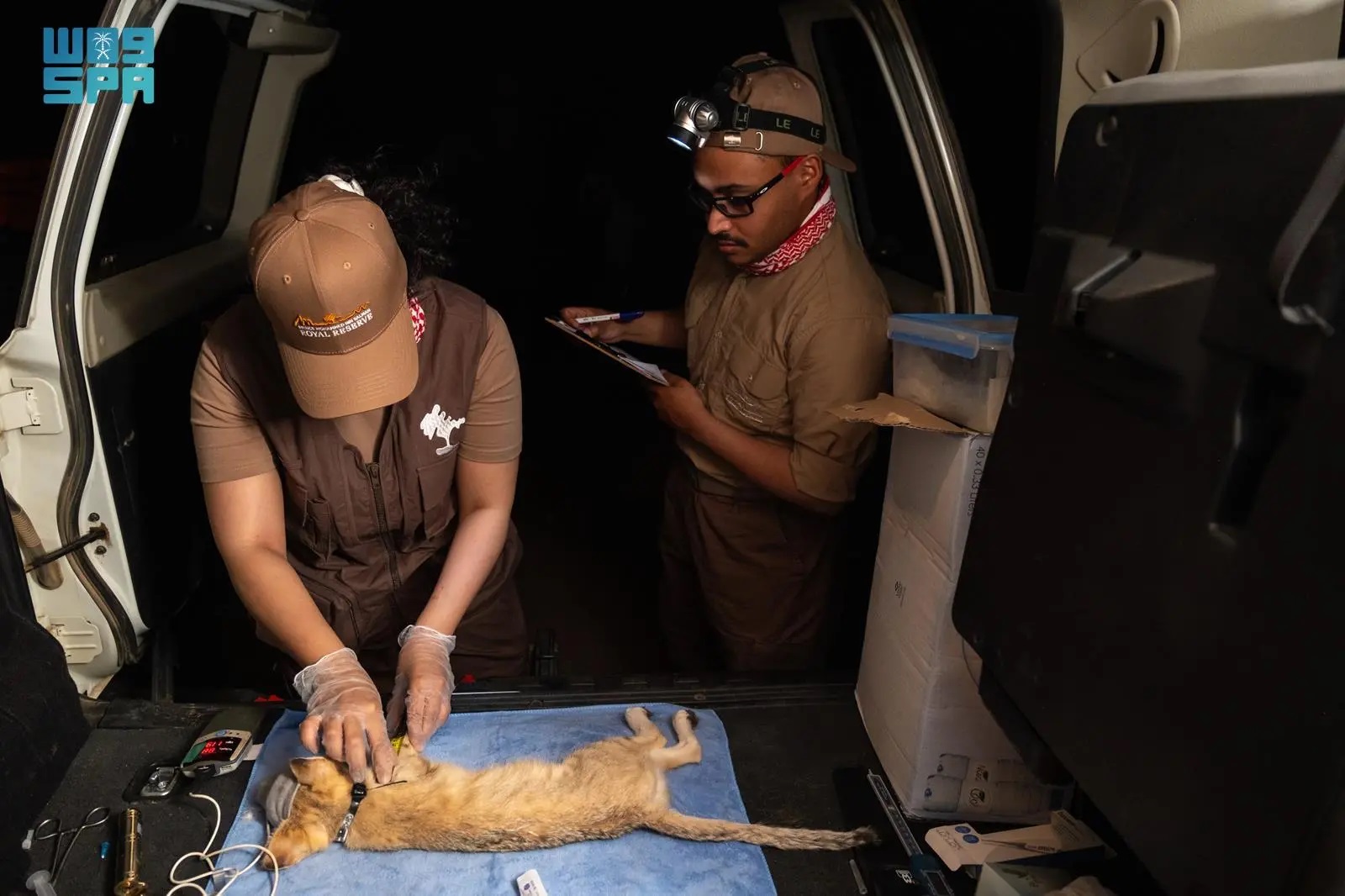
In line with Institutional Animal Care and Use Committee (IACUC) best-practice standards, three male and three female sand cats were safely captured by the reserve ecologists, assessed by experienced veterinarians, and fitted with custom-designed lightweight GPS collars. Each collar weighed less than 3% of the animal’s body weight and incorporated a timed drop-off mechanism, enabling it to detach after around three months for retrieval and re-use while minimizing disturbance to the animal.
As the species is primarily nocturnal, collars were programmed to record GPS locations at two-hour intervals between 18:00 and 06:00. Over a cumulative period of 635 monitoring nights, the program generated more than 3,000 GPS location points, providing unprecedented insight into home ranges, den use, habitat preferences, and interactions between individuals.
Senior Ecologist Josh Smithson said: “Historically, sand cat research has been hindered by the species’ small size and reliance on VHF technology, which is both labor-intensive and provides less data than modern systems. We worked with global telemetry experts to develop the first GPS collar light enough to be fitted to sand cats without impairing their activity, weighing just 50g. By pairing detailed movement data with genetic sampling from the same animals, we are significantly advancing global understanding of the species and its conservation needs.”
The sand cat is the only wild feline species adapted to live year-round in desert environments and to survive in extreme arid climates. With fur-covered foot pads that enable movement across hot sand without leaving tracks, it can obtain all the moisture it needs from its prey and possesses extraordinary hearing capabilities, specifically evolved to detect prey moving underground in harsh, arid habitats.
Their large ears, which function like radar dishes, pick up the faint, low-frequency sounds of rodents, reptiles, and insects moving beneath the sand surface. In the face of climate change and desertification, the sand cat offers an important indicator of how biodiversity can persist or fail in rapidly changing, extreme environments.
Sand cats are considered an important indicator species within arid ecosystems. Understanding sand cat movements, habitat use, and genetic diversity provides insight into prey availability, habitat connectivity, and overall ecosystem function. As restoration progresses across the reserve’s terrestrial landscapes, monitoring species such as sand cat helps the reserve wildlife ecologists assess whether ecosystems are recovering at a scale capable of supporting a full range of native wildlife.
The reserve is committed to advancing species conservation and scientific knowledge nationally and regionally, and to setting the benchmark for deploying and trialing new conservation techniques that support its restoration mission. Its team has already developed a more advanced collar design with capacity for a second battery, extending deployment time, alongside a controlled drop-off mechanism. Monitoring of sand cats continues by rangers, ecologists, and carefully stationed camera traps at den sites.
Tracking technology is now being used by the reserve across land, air, and sea to understand the movement patterns of species, including the griffon vulture across the Middle East, hawksbill and green turtles in the Red Sea, as well as the desert sand cat. To date, the reserve has published eight peer-reviewed papers and remains committed to sharing its findings and data with the global scientific and conservation community.